
Battery technology is not what decides whether a Swiss BESS project happens. Grid position and permitting are. Here is what actually gates a project, why the answer differs from one municipality to the next, and what a site needs to show before it is worth taking further.
Lithium-iron-phosphate systems are a mature, commoditised product with a competitive supply chain. Specifying one is a procurement exercise. What determines whether a Swiss BESS project reaches construction is something far less portable: whether a specific parcel, in a specific municipality, connected to a specific distribution operator, can obtain grid capacity and a building permit.
Switzerland's distribution system has hundreds of operators. Physical connection capacity is assessed by the responsible operator within the applicable federal electricity framework; zoning and building requirements also depend on cantonal and municipal planning rules. A nearby substation therefore does not establish connection rights, and a viable network position does not establish permission to build.[1, 2, 7, 8]
Site screening in Switzerland is therefore not a search for good land. It is a search for a viable grid position that happens to have land attached to it.
An April 2026 survey of Swiss distribution grid operators — covering operators representing some 8,600 MW of coincident network load — found connection demand from large batteries already exceeding what existing networks can absorb. The pattern it describes is the single most useful thing a developer or landowner can understand before spending money on a site.[1]
| What the survey found | Observation | Why it matters to a project |
|---|---|---|
| Queue congestion | 7 of 9 operators had pending connection requests exceeding 10% of their network load | Realisation without network expansion is described as not realistically possible at that volume |
| Waiting lists | A quarter of operators maintain them | Grid capacity is allocated over time, not on demand |
| Constrained agreements | Half apply individual connection agreements with limited feed-in or withdrawal capacity | A connection may be granted but capped — the technical envelope is a negotiated outcome |
| Voltage-level assignment | Surveyed operators propose grid level 3 for batteries from roughly 4–5 MW | A recommendation for clarification, not an established nationwide threshold |
| Speculative applications | First-come-first-served filing blocks capacity | Serious projects compete with placeholder applications for the same headroom |
Two practical consequences follow. First, connection feasibility has an operator-specific answer that should be obtained early. Second, the requested import/export power helps determine the appropriate connection point and technical requirements. The survey's roughly 4–5 MW proposal is not a national connection rule: the responsible operator must confirm the actual network level and capacity envelope. Transmission connections have a separate Swissgrid application process.[1, 2]
A grid-scale BESS requires the applicable planning and installation approvals. Zoning, building requirements and the responsible authorities must be established for the site; the electrical connection, substation or lines may also require federal plan approval. The procedure cannot be inferred from the battery's container format alone.[7]
An industrial or commercial zoning designation can simplify the planning assessment, but does not itself grant approval. Outside building zones, construction is subject to restrictive federal spatial-planning rules and a cantonal assessment. Zug's official guidance illustrates the need for cantonal consent and municipal approval; the applicable procedure must be checked in the project's own canton.[8]
Test zoning and the applicable approval route early. Excellent grid proximity does not compensate for an unresolved land-use constraint; an exception outside a building zone must be evidenced rather than assumed.
The purpose of a first BESS site screening is not to prove a project works. It is to rule sites out cheaply, before anyone commissions a study. Six things carry most of the decision.
Distance to a substation or suitable medium- and high-voltage infrastructure, and which distribution operator controls it. Proximity is the single most decisive factor.
Whether the parcel sits inside a building zone and whether the designation accommodates a technical installation of this kind.
Whether the operator has capacity at that node, or whether the project is placed on a waiting list or offered a capped connection agreement.
Sufficient area for a containerised system, plus safe permanent access for installation, maintenance and emergency services.
Proximity to residential use, protected areas, groundwater zones or other constraints that turn a routine permit into a contested one.
Whether the owner is willing to enter a long-term arrangement, and whether the person negotiating actually holds the authority to do so.
The network-charge rules distinguish storage without end consumption from storage serving end consumption. Standalone storage without end consumption is exempt from network-use charges under the rules applying since 2025. From 1 January 2026, eligible storage with end consumption can obtain reimbursement of defined energy-related charges for electricity drawn, stored and re-fed to the grid. This is not a domestic-only category or a blanket exemption of every battery's capacity and basic charges: metering, eligible quantities and the applicable operator process must be confirmed.[3]
The demand side is moving faster than the framework. Swissolar's Batteriemonitor puts storage on a steep growth path in the Swiss energy system, and behind-the-meter installation volumes have been rising sharply. Grid-scale projects are being announced by established Swiss utilities. The constraint is not appetite; it is the rate at which network capacity and permitting practice can absorb it.[4, 5, 6]
For anyone assessing a site today, the sensible posture is to treat the regulatory position as a variable to be verified per project and per operator, not as a settled national parameter. That verification is unglamorous work, and it is where most of the risk actually sits. What that capacity costs when it is contracted is a separate question — we examine it in our analysis of the Netzkostenbeitrag.
The same constraint reads differently depending on where you sit in a project.
The question is not what the land is worth in general, but whether this parcel holds a viable grid position and a workable zoning designation. Both are checkable before any commitment is made. Land for battery storage
An existing connection is an asset. The question is how much headroom it carries, and whether storage can be integrated behind the meter without triggering a connection upgrade. Industrial sites
With capacity contested and conditions operator-specific, credible battery storage development depends on disciplined screening — ruling sites out early and cheaply so effort is concentrated where a path exists. Developers & partners
Source corrections and excerpts checked on 7 October 2026. Original-language fragments are labelled; source dates and scope are stated below.
Der Befragungszeitraum war im April 2026.
CurvatureEnergy translation: “The survey was conducted in April 2026.”
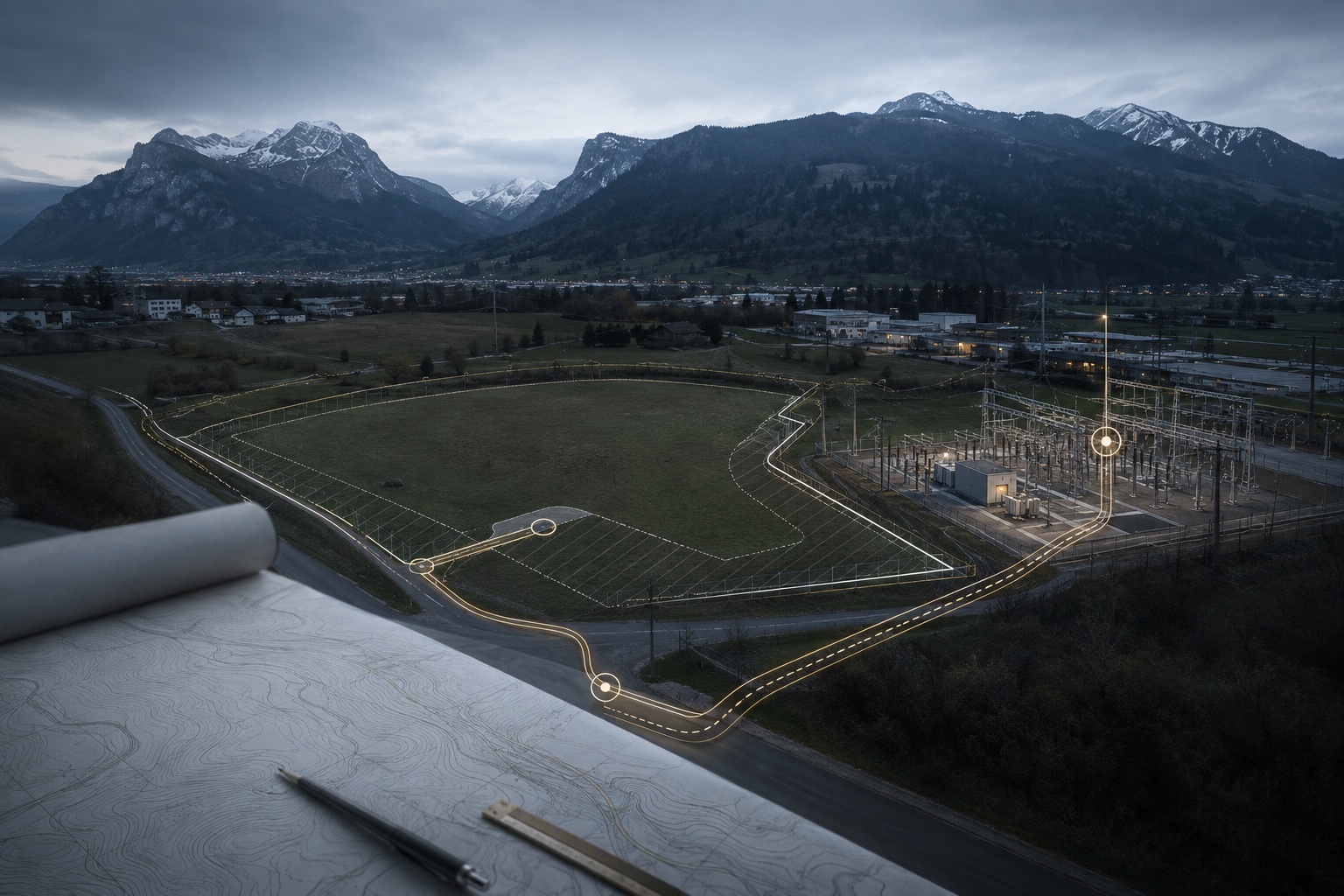
Header image: AI-generated illustration for this analysis, not a photograph of an existing project or evidence of a specific site, connection or approval.