
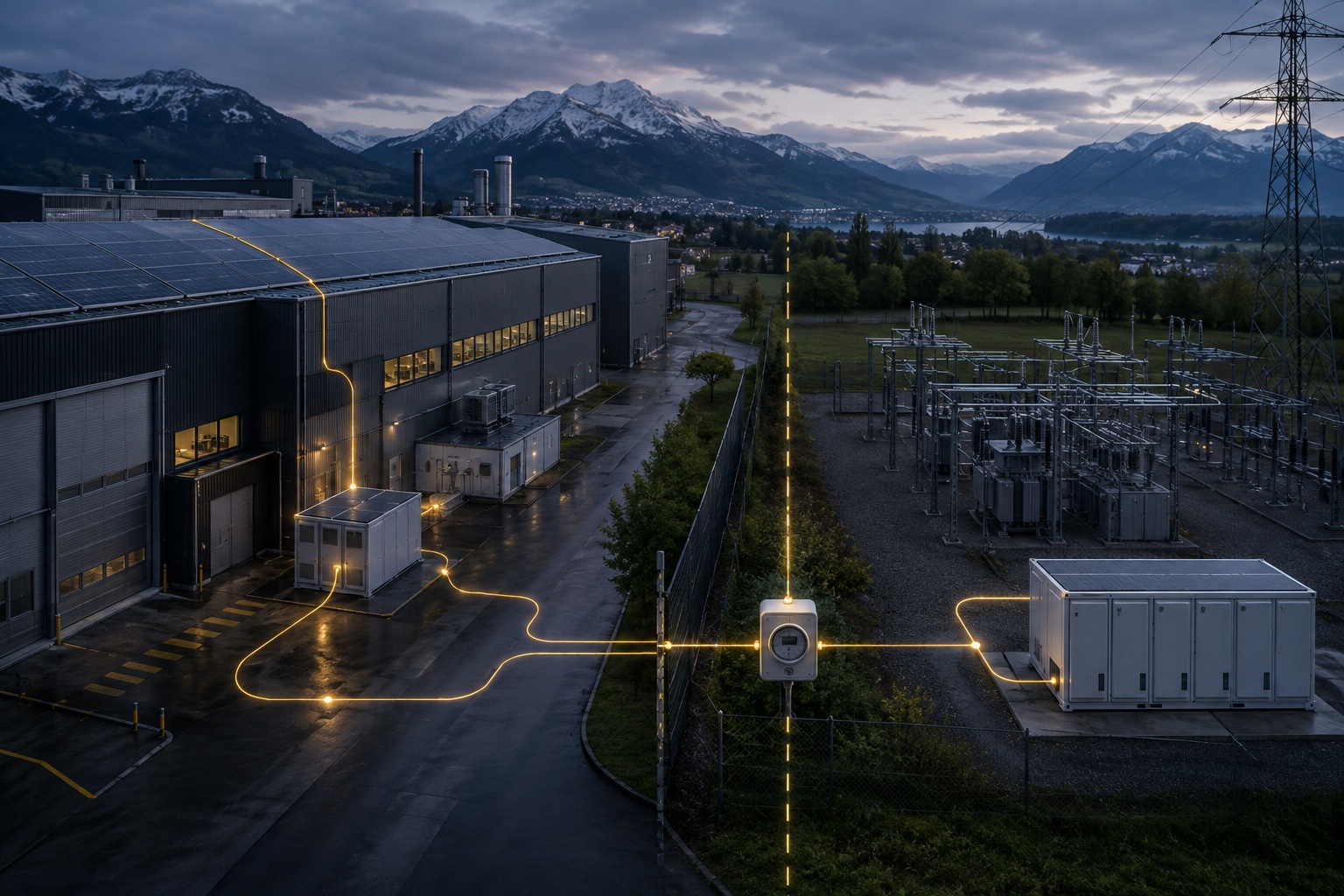
A standalone battery and an industrial behind-the-meter BESS perform different jobs. Reserve-capacity tenders can become more competitive as qualified supply grows; on-site peak shaving and PV integration respond to a particular host's load. Here is why that distinction matters in Switzerland.
A standalone battery can provide frequency reserves, activated balancing energy and wholesale flexibility. These are different markets. The system operator sets the capacity it procures for a defined reserve product and delivery period; activated energy depends on real-time imbalance, while wholesale demand also reflects trading conditions. More batteries do not automatically create more demand for a particular reserve-capacity tender.
For a given product and period, each qualified battery competes with other eligible resources for the tendered capacity. If qualified supply grows faster than that procurement requirement, competition can compress prices. This is a product-specific competition argument, not a claim that all balancing or wholesale demand is fixed.
At a grid node, a battery competes for specific market products. Behind an industrial meter, it can also perform a site-specific job: peak shaving and PV integration. Fleet growth elsewhere does not remove that local requirement.
Modo Energy reports a 73% decline in British frequency-response revenues in 2023. Separately, its Dynamic Containment Low (DCL) example shows sharp price compression once available battery capacity exceeded 1.5 times demand for that product. Its October 2025 German scenario compares a projected 5.7 GW battery fleet at end-2026 with 2 GW of aFRR capacity procurement: 35% of that fleet would amount to approximately 2 GW. This is an analyst scenario, not a measurement of the fleet today.[1]
| Market | Procured reserve demand | What the numbers imply |
|---|---|---|
| Great Britain | Frequency-response supply overtook demand | Frequency-response revenues fell 73% in 2023; the 1.5× threshold refers specifically to DCL pricing |
| Germany | 2 GW aFRR in Modo’s October 2025 scenario | A 5.7 GW fleet with ~35% prequalified would cover the entire aFRR capacity requirement alone |
| Switzerland | 80 MW FCR allocation for 2026; not the entire balancing market | Useful scale comparison, not a ceiling on accessible FCR procurement or on other balancing products |
The Swiss number deserves a pause: Swissgrid's roadmap assigns approximately 80 MW of FCR to Switzerland for 2026. That is one product's national allocation, not the entire balancing market. Axpo's 50 MW / 100 MWh Gurtnellen project began construction in September 2025 and exceeds half that allocation by power. This does not imply that its full capacity qualifies for or will be offered into FCR.[2, 3]
Swissgrid is widening access and reducing product-specific minimum bid sizes through 2026–27. Procurement requirements and activated energy can change: Swissgrid reports that renewable variability increased balancing-energy needs, while better forecasting and operational measures later reduced activations. A project must therefore test competition and operating requirements product by product, not assume one fixed national pool.[2, 4]
Move the same battery behind the meter of an energy-intensive site and its primary job changes character. Cutting a factory's peak demand, raising the self-consumption of an on-site PV installation, keeping a site inside its connection limit — these are services performed for one specific host, under contract, against that host's own load profile. They are not auctioned against the national fleet. When the tenth or the hundredth battery connects somewhere else in the country, the December peak of this factory still needs shaving, and a suitably controlled on-site battery can address it. Other measures, including load management, may also contribute.
Grid services remain a possible additional role. When the site leaves usable power and energy headroom, a battery can offer external flexibility if connection permissions, product prequalification and control priorities allow it. Site savings should be evaluated separately from those market services: adding a service must not undermine the host obligation or double-count the same capacity.
An existing industrial connection can reduce the need for new capacity if the BESS remains within confirmed import/export limits and operating conditions. The operator must verify available headroom, battery-compatible connection rights and any required protection, upgrade or approval. Behind-the-meter siting is not an automatic exemption from connection review or a queue.
The right duration follows the host’s load profile: the length and spacing of peaks, charging opportunities and the binding annual constraint. In our illustrative industrial BESS + PV case study, a model based on a full year of quarter-hour load data tests a December cluster of consecutive peak hours. It demonstrates a sizing method, not the measured performance of an operating installation.
Longer duration increases available energy at the same power, but the useful gain depends on charging opportunities, usable capacity, efficiency and state-of-charge reserves. Compare two-hour and four-hour configurations against the required duty and total system costs. Meeting a peak with a shorter system does not, by itself, prove that a longer-duration system is unsuitable.
The siting question reads differently depending on what you hold — but it points the same way.
A meaningful electricity bill, recurring peaks and an existing connection make a site worth testing for storage. Confirm the load profile and usable connection headroom before choosing a configuration. Industrial sites
Proximity still rules — but proximity to load and grid together beats bare grid proximity. Land adjoining industrial zones carries a siting logic that pure node plays lack. Land for battery storage
Projects anchored to a documented site-specific job have an additional operating purpose. Assess that purpose separately from eligibility, competition and delivery obligations in each balancing product. Developers & partners
Source corrections and excerpts checked on 7 October 2026. Original-language fragments are labelled; source dates and scope are stated below.
frequency-response revenues fell by 73%
80 MW der Schweiz zugewiesen
CurvatureEnergy translation: “80 MW allocated to Switzerland”
100 MWh Energie speichern
CurvatureEnergy translation: “store 100 MWh of energy”
Header image: AI-generated illustration for this analysis, not a photograph of an existing project or evidence of a specific site, connection or approval.